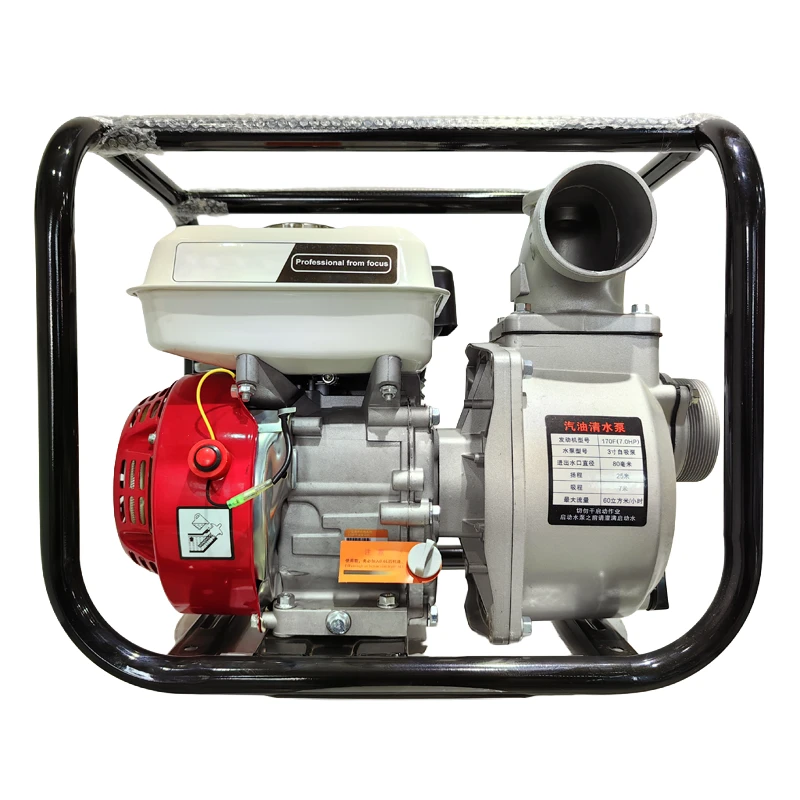
Agricultural water pumps come in various types based on their structural design and method of operation, catering to diverse irrigation and drainage needs. The most common type is the centrifugal pump; it utilizes the rotation of an impeller to generate centrifugal force for moving water. Characterized by high flow rates, simple construction, and versatility, it is well-suited for field irrigation and general water supply applications.
Another common type is the self-priming pump. Its key feature is that the pump body does not require full priming before startup; thanks to its effective self-priming capability, it offers greater operational convenience. These pumps are frequently used in rural small-scale irrigation systems, particularly in environments with shallow water sources or complex water-extraction conditions.
Other types include submersible pumps and axial-flow pumps. Submersible pumps operate while fully submerged, making them ideal for deep-well extraction or areas with deep water levels; they are known for stable operation and high efficiency. Axial-flow pumps, meanwhile, are suited for high-flow, low-head drainage or irrigation scenarios-such as draining waterlogged low-lying fields or large-scale water conveyance projects-and play a vital role in agricultural flood control and drainage.